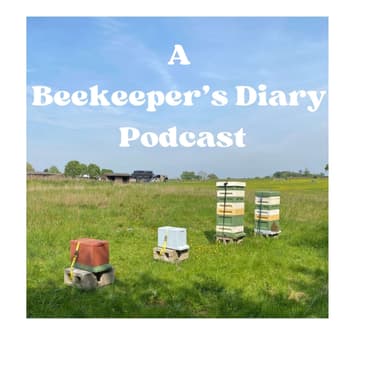
Today I talk about taking off a couple of supers, one for me and one left for the bees. Varroa treatment starts today, 6-8 weeks to go. Hive is now reconfigured for winter. One super under the brood box, ready to move back on top in the spring.
Welcome back to a Beekeepers' Diary podcast. We are now around the 10th of August, very much towards the end of the season over here. So far today, I've not inspected the brood nest, so I didn't think I could meaningfully do anything of use today. What I have done is I had two boxes, two supers above the brood nest, which I was using to collect nectar for honey. So what I have done is I've checked both of them to see how many frames they've got. Both of them are pretty full. So I've taken one box off for me. So I should get a few jars of honey from that. Not very many mine, not compared to the 300 odd I had last year. Very much in a 20 jar situation this year. But the important thing is I'm back with bees and hopefully in a good place for next year. We should be back on track. But this year I've taken one box that's in the car boot. probably with a few bees in it. That'll surprise me when I get home. And the other one I have put underneath the brood box, which is my preferred winter formation. So I've got my floor, a super of stores and my brood box. And I find that gives me enough room to feed enough syrup for winter. raises the bees a bit higher off the floor and inevitably when I come back in the spring that super will be empty. The bees will have moved up to the top of the brood box and I will be able to put that super back on top to start being the first super on the box for the next season. So I've got my winter formation. Bees didn't enjoy that but they've settled back down now. I can see them now just going about their business. Obviously I've disturbed the formation of how they've arranged their stores and everything but this gives them time to reorganise for winter. What I have done as well is I've started my Varroa treatment using that easy Varroa check with CO2 the last couple of weeks. It looks like I've got a very low Varroa count but Having had the disaster of last winter, I don't want to take any chances. So I have started Apistan Varroa treatment, which I've never used before. I've generally used Apigard. So I don't think there will be any resistance locally to this. I know my local association doesn't use this. So let's see. I'll look at the Varroa drop when I come back next week. So... For non-beekeepers, it means I've put, normally at the bottom of my beehive, I've got a mesh, but you can slide a board in underneath to seal off the bottom of the beehive and put something sticky on that floor, like oil or Vaseline, something like that, and then whatever drops off the bees will be collected. Excuse me, Mr. Bee, no thank you, or Mrs. Bee, rather. Put my hands in my pockets when I'm getting investigated. Yeah, the Varroa that are killed will drop off onto the board and will get stuck there. So when you come back, you can draw the board out and see how bad the Varroa infestation is or was. So we'll see how that goes. I've put two strips in. They sort of hang between the frames with this treatment. And they've got sort of a V-shaped... construction at the top so you can sort of snap it into shape and slide the sort of gelatinous strips in between frames three and four and seven and eight so the bees have to walk across those strips and the treatment is delivered as I understand it I could have that completely wrong but I think that's how this one works so we'll leave that in for six to eight weeks we won't leave it in longer because that is how resistance develops when people forget to take it out, leave it in, and then the mites become accustomed to living with that treatment in, so it's very important to remove it at the correct time and not leave it in. Sometimes some of the smelly treatments can make all your bees come out of the hive and sit out the front because it stinks in the hive, but I'm not seeing any of that at the moment, and this treatment doesn't seem to be a smelly one. So that's all good. Nature-wise, I can still see the swallows. They're congregating in, you might be able to hear them now. It's a lovely sound. Make the most of it for the next week or two before they go back. They're starting to congregate in larger groups before making the long trip back south for winter. But I'm enjoying that. A few red kites overhead. There was a goldcrest in the lime tree when I turned up in my car. Calling away, that was nice. Not everyone can hear goldcrest because of the frequency they call at. As you get older, you're supposed to lose the ability to hear goldcrest, but I'm still hanging in there. Other than that, all is good. Thank you to all my new listeners. Nice to have you. Thank you to... my colleagues that have listened as well, much appreciated. I'll see you in the week and for the rest of you, I'll speak to you next week. Have a good one.