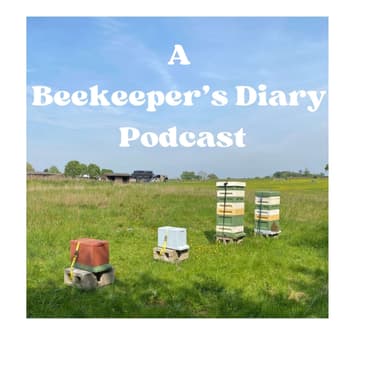
An audio chat from beside the hive, varroa monitoring using CO2 and a bee has a good check on my bee suit.
Welcome back to a beekeeper's diary podcast. Goldfinches flying over my head. Swallows are still zooming about. It's towards the end of July now. It's getting ready to rain.
So the swallows are flying low as the insects push down from the atmospheric pressure and the bees are a little agitated as they can be when it's about to rain. We've had to go through the hive, a little wander through the hive. Well, first of all, spent some time looking at the entrance, checking for any wasp incursions this time of year when the wasps are leaving their nests and they're getting desperate for food. They can start raiding the bees and try and overrun the bees. But here, this year, I watched the entrance for five minutes, zero wasp incursions, So that's good.
Sometimes you can have to make the size of the entrance. Being attacked by me. Excuse me. As I say, they're a bit angry. Put my put my veil on.
You hear that? I'm being investigated by a grumpy bee. No, thank you. No, thank you, madam. Not today, please.
I don't mind being stung, but I can do without being stung in the face. So where was I? Yeah, can reduce the entrance block for the bees to make it easier for them to defend their territory and make it hard for the wasps to get in. But I don't need to do that at the moment. I've seen zero hornets.
Last year I was getting predated by hornets as well which was fun to see if I'm honest as an insect enthusiast. They would grab the bees outside the entrance of the hive, fly off to a nearby perch, bite the head off, and then zoom off with the carcass. But none of that this year. Yes, so we had a little look through the hive, not much has changed. The boxes that we are trying to collect honey in haven't changed much.
They've capped a lot of it off, but there's no point me taking it off yet. I'll leave them to it. Probably for one maximum two weeks, then I'll have all those boxes off because I then want to start my varroa treatment which are the mites that predate on the brood that the bees are laying and can weaken them and we're getting to the time of year where the bees that are created now are our winter bees, so we need them to be strong and healthy to get through the winter. And if you leave your varroa treatment too late, your weakened bees won't make it through the winter. So, for me August is when I start the treatment and I'm going to try a different treatment this year.
I'm going to try Apistan which is a couple of strips that you place into the brood box six to eight weeks no longer rather than ApiGuard which is what I normally use, but I thought I'd try something different this year, see how we get on. And that treatment is a tray of crystals that you place at the back top of the hive and the bees drag it through the hive to eject it because it smells and that sort of drags the treatment through the hive. So, I'm gonna try Apistan this year, slightly different treatment, see how I get on. I tried a new device just now which is I can't remember the commercial name for it, but it's basically a pot. And to measure your Varroa levels, what you can do is collect a sample of 300 bees, sacrifice that small percentage of bees for the greater good and put them in isopropyl alcohol something like that which kills them instantly and then that the Varroa mites that are on the bees will drop off, you can sieve them out and you can get the percentage of Varroa to be level.
But I was trying today, my first try with this device, you collect 300 bees and you inject CO2 into the cup and seal it and it anesthetizes the bees. Then you shake them about gently and the theory being the varroa that are on the bees, prophetic varroa, will drop off through a little sieve and you count the Varroa in the cap that's dropped off the bees. So I did that which is very effective. Of note, I put the bees back into the frames. They all came round and wandered off.
So no casualties, but no varroa either. So I don't know whether I need to reread the instructions and, well, I'll continue. The joy of that technique is you can continue your sampling week to week and monitor your levels throughout the year. So I'm going to do that. But my initial sample today is zero for hour which is good but seems unlikely.
We shall see. So yeah, oh and of also of note, there are not very many eggs. The queen saw the queen, she's in there, there's plenty of open cells but she's not laying very much which is typical for this time of year when there's a dearth there's nothing for the bees to collect. Have a little rest before they start preparing for winter. So we'll have another look next week and see if she's, sprung back into action.
But very much static state of affairs. Thank you to all my new listeners. Thank you to my new listeners from within my colleagues that have kindly said they've listened and enjoyed. So hi to you. Look forward to your feedback.
And yeah, all is good. I will catch you next week.